
The history of Trianel Wind Farm Borkum I
| January 2008 The “Borkum West II” offshore wind farm project developed by Prokon Nord is well received by Trianel’s shareholders: Trianel and around 40 municipal utilities join the project development. |
| April 2008 The project company, today’s Trianel Windkraftwerk Borkum GmbH & Co. KG, is founded. |
| September 2009 A preliminary agreement for the supply and installation of 40 “Multibrid M5000” wind turbines is concluded with Multibrid GmbH (later AREVA Wind GmbH). |
| December 2009 The European Commission selects the project for the European Energy Programme for Recovery (EEPR) and pledges EUR 42.7 million in funding. |
| April 28, 2010 The final turbine supply contract is signed with Multibrid GmbH (renamed AREVA Wind GmbH in June 2010). |
| July 2010 Transmission system operator TenneT gives an unconditional commitment to connect the wind farm to the grid by February 2013. |
| December 2010 The 34 shareholders take the decision to build the first expansion phase. The project financing of around EUR 550 million is signed, including loans from the European Investment Bank. |
| Spring 2011 Preparations and planning for the scheduled start of construction in August 2011 are under way. |
| June 2011 Preparations are made to protect marine mammals during construction with the large bubble curtain. In the research project HYDROSCHALL-OFF BW II, funded by the German Federal Environment Ministry, Hydrotechnik Lübeck GmbH, BioConsult SH GmbH & Co. KG (Husum) and itap GmbH (Oldenburg) test this noise mitigation technology on a large scale during the construction of Trianel Wind Farm Borkum. Following tests on land and first tests at sea in August 2011, it is used from the start of construction. |
| September 1, 2011 Start of construction. First pile driving at sea: the jack-up barge “Goliath” drives the first piles for the foundations into the seabed. |
| March 2012 In Bremerhaven, AREVA hands over the first 20 of 40 wind turbines to Trianel. Six months after the start of construction, the jack-up barge “Goliath” has driven the piles into the seabed at 35 of the 40 turbine positions. |
| June 2012 All 120 piles have been driven and the first tripods are being transported to the construction site. TenneT announces that the grid connection will be delayed by four to five months. |
| September 2012 In Bremerhaven, shipment of the 40 wind turbines for Trianel Wind Farm Borkum has begun. The nacelles, rotor hubs and tower segments are shipped to Eemshaven in the Netherlands, the base port for installing the turbines at sea. |
| October 2012 19 of the 40 tripods are anchored to the seabed. Due to delays in the grid connection, in tripod manufacturing and in the offshore substation, the installation of the turbines is postponed. |
| Early 2013 After the winter break, foundation work resumes. The substructure (jacket) for the offshore substation is brought to the construction site and installed. |
| April 2013 The heavy-lift vessel “Oleg Strashnov” installs the wind farm’s offshore substation at around 20 m above sea level. All 40 tripods are in place, and the wind farm’s foundations are complete. |
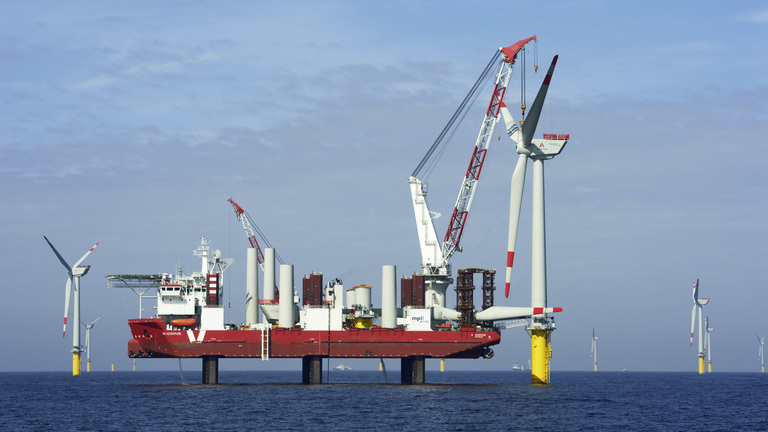
| July 2013 The installation vessel “MPI Adventure” begins installing the 40 wind turbines. On July 27, 2013, the first turbine is complete. |
| June 2014 After just under eleven months, all 40 wind turbines have been installed. As the grid connection is not yet available, they cannot feed in electricity yet. |
| December 2014 On December 23, the wind farm is permanently connected to the mainland via TenneT’s DolWin alpha converter platform. |
| February 2015 After a grid connection delay of around two years, the first turbine starts trial operation; the others are connected step by step. |
| July 2015 All 40 turbines are connected to the grid and in trial operation. |
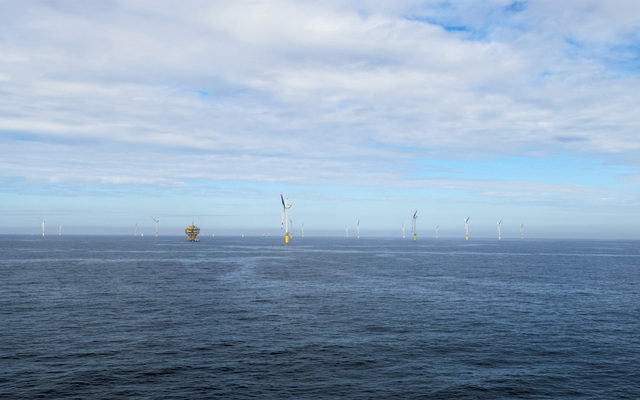
| September 1, 2015 Johannes Remmel, Environment Minister of North Rhine-Westphalia, officially inaugurates Trianel Wind Farm Borkum together with Trianel and the participating municipal utilities. The wind farm is producing at full capacity. |