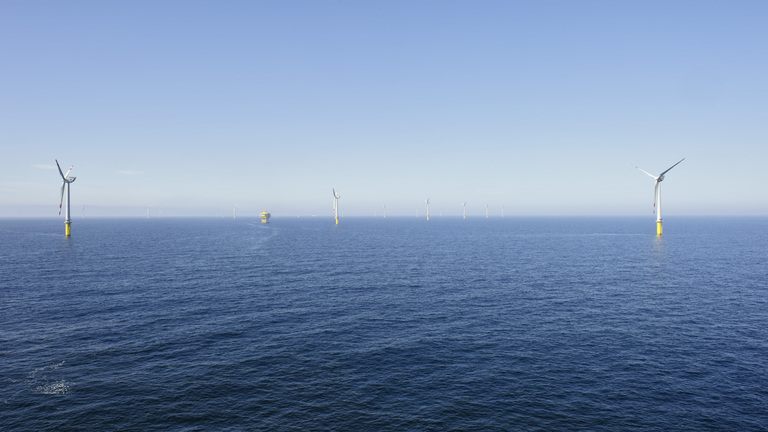


Strict requirements from day one
Anyone building and operating an offshore wind farm in the German North Sea must meet binding environmental requirements set by the Federal Maritime and Hydrographic Agency (BSH): from surveys before construction and noise limits for pile driving to monitoring during operation under the BSH Standard Investigation Concept. These requirements apply to all offshore wind farms. We implement them at Trianel Wind Farm Borkum – and the construction of our wind farm helped to move underwater noise protection forward.
Nature conservation and offshore wind – how do they fit together?
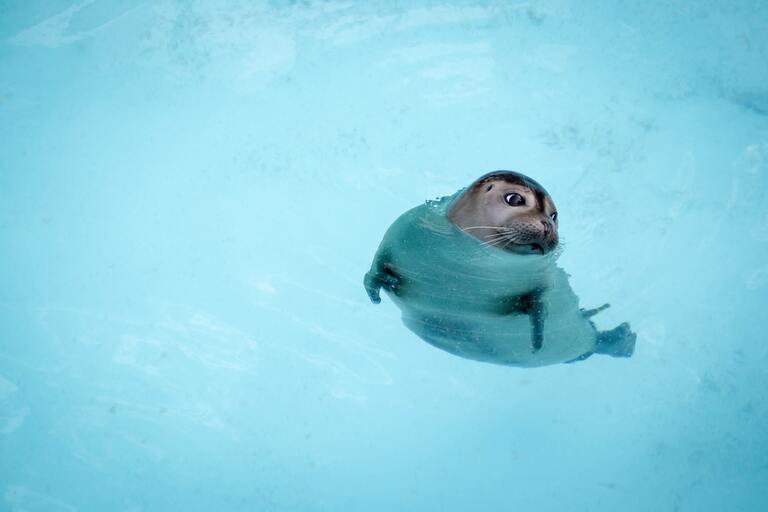
Offshore wind farms affect the marine environment, with both adverse and positive effects. According to the Federal Agency for Nature Conservation (BfN), construction noise is one of the most serious impacts, mainly on harbour porpoises. During operation, the foundations create new habitats, while some seabird species avoid wind farms. This is why the BSH assesses the impacts before granting approval and accompanies operation with monitoring; afterwards it may require further investigations on a case-by-case basis. The BSH evaluates data from many wind farms jointly and over several years.
Baseline surveys
Before construction may begin, the marine environment at the site is surveyed over at least two complete seasonal cycles. The surveys cover the protected assets specified by the BSH: seabed communities (benthos), fish, resting and migratory birds, and marine mammals such as harbour porpoises and seals, using sampling as well as counts by ship and aircraft. At the same time, a comparable reference area outside the wind farm is surveyed. This makes it possible to distinguish later changes from natural fluctuations, for example those caused by the migratory behaviour of many species. Reliable statements on the long-term development of individual species, however, require long time series.
Monitoring during operation
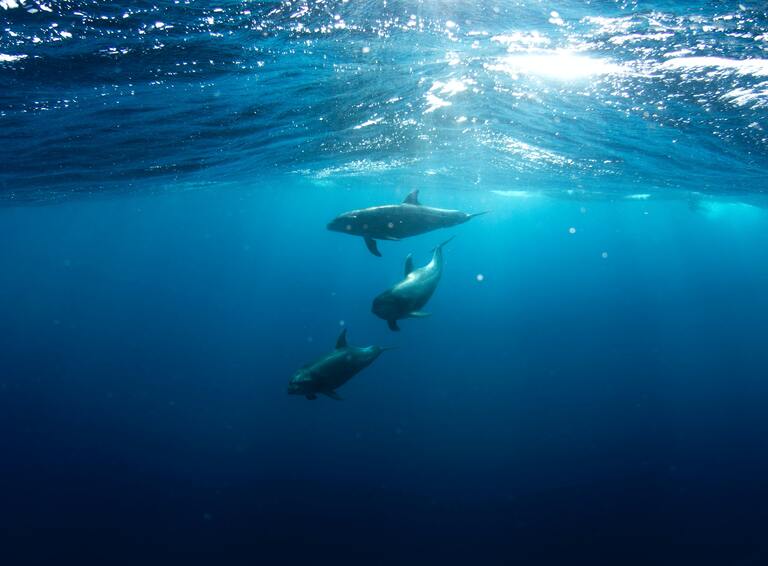
The BSH approval for our wind farm (then called “Borkum West II”) requires monitoring during construction and operation under the Standard Investigation Concept, including the recording of harbour porpoises with underwater click detectors (PODs). Under the StUK 3 standard applicable at the time, operational monitoring lasts at least three and, if necessary, up to five years. Trianel Wind Farm Borkum is part of the “Nördlich Borkum” cluster, whose joint environmental monitoring from 2013 to 2019 is documented in expert reports published by the BSH. Because many species are only temporarily present in the North Sea, the BSH evaluates the data across wind farms and over several years.
New habitats on the foundations
Only vessels involved in operation, maintenance, research and rescue may enter the safety zone around the wind farm (general decree of the Federal Waterways and Shipping Agency), so there is no fishing there. Crabs, mussels and other invertebrates colonise the foundations and rock armour, and new communities of life form. At the same time, the original soft-bottom habitat is lost beneath the foundations and scour protection; according to the BSH, the additional species most likely come from natural hard substrates nearby (BSH environmental report N-3.6, p. 111, in German). The Thünen Institute observes a reef effect at offshore wind farms in the German Bight, with distinct fish communities including cod, mackerel and pouting, and describes wind farms as fishing-free areas. The new inhabitants also include non-native species such as the Pacific oyster, for which the foundations can act as stepping stones for their spread (Coolen et al. 2020).
Seabirds
Not all species benefit. Monitoring in the “Nördlich Borkum” cluster, which includes Trianel Wind Farm Borkum, found statistically significant avoidance of operating wind farms by loons, northern gannets, terns and auks (final report on resting birds 2013–2019, published by the BSH, summary, pp. 2–3, in German). According to the BSH’s analysis of the cluster data, avoidance extends to at most 2 km for northern gannets and little gulls and possibly up to 4 km for common guillemots and razorbills; terns avoid only the wind farm area itself (BSH environmental report N-3.7, p. 121, in German). Loons react most strongly: a study by Garthe et al. (2023) found a 94% decline within wind farms and a 1 km buffer in the German Bight, with measurable effects up to 9–12 km away. The BSH describes this as partial rather than complete avoidance (BSH environmental report N-3.6, p. 126, in German).
Migratory birds
In spring and autumn, large flocks migrate along the coast and across the open North Sea. They may avoid wind farms, but they can also collide with turbines, especially at night and in poor visibility, when illuminated turbines attract birds (Hüppop et al. 2006). On the FINO 1 research platform in the “Nördlich Borkum” cluster, no event involving a larger number of collided birds has been recorded since wind farm construction in the cluster began in 2013. According to the experts, a collision risk for nocturnal migration can neither be identified nor ruled out; for daytime migration and migrating seabirds they rule it out (final report on migratory birds 2013–2019, published by the BSH, summary, p. 19, in German).
Marine mammals during operation
In the final report on the “Nördlich Borkum” cluster for 2013 to 2019, the experts found no clear overall avoidance of the wind farm areas by harbour porpoises; detection rates inside and outside the wind farms did not differ fundamentally. Within Trianel Wind Farm Borkum itself, however, the underwater click detectors mostly recorded only low porpoise activity. The experts name pile driving in the neighbouring wind farm and natural factors as possible causes; a weak avoidance effect during operation, most likely due to wind farm vessel traffic, cannot be ruled out. The operating wind farms had no disturbing effect on seals (marine mammal monitoring report 2013–2019, published by the BSH, summary, pp. 4–5, in German). According to the BSH, operational monitoring in the German North Sea has so far found no evidence that harbour porpoises avoid wind farms (BSH environmental report N-3.6, 2022, p. 123, in German). Studies at other sites show varying results (Scheidat et al. 2011; Teilmann & Carstensen 2012); harbour seals and grey seals deliberately visit wind turbines, presumably to forage.
Our conclusion
Offshore wind farms are an intervention in the marine environment: they create new habitats on the foundations, but also displace some species. That is why strict requirements, careful monitoring and technologies that measurably reduce impacts matter, such as the large bubble curtain, which was tested during the construction of our wind farm.
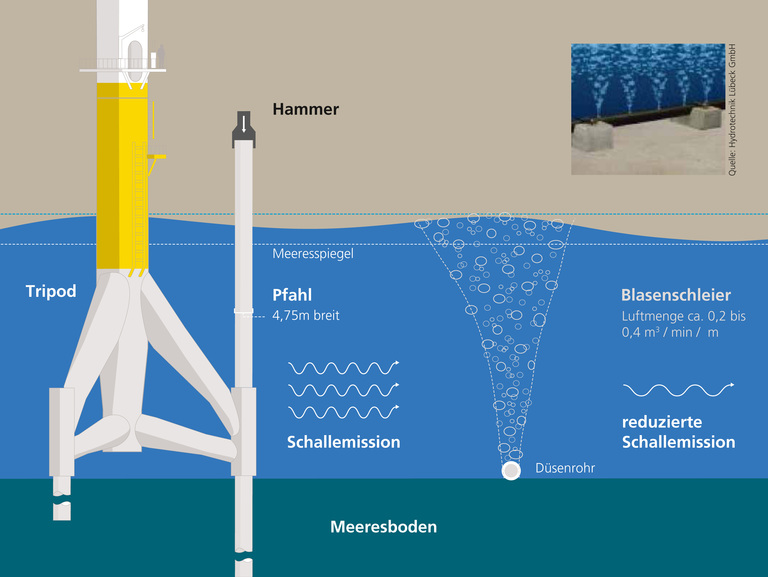
Large bubble curtain – a milestone in noise protection
Pile driving for the foundations generates intense underwater noise that disturbs and can harm marine mammals, especially harbour porpoises. This is why binding limits apply in Germany: 160 dB sound exposure level and 190 dB peak level at a distance of 750 m.
During the construction of Trianel Wind Farm Borkum, the large bubble curtain was used for pile driving from the start of construction in September 2011, at 31 of the 40 foundations. In the research project HYDROSCHALL-OFF BW II, funded by the Federal Environment Ministry and carried out by BioConsult SH, Hydrotechnik Lübeck and itap, it was developed further: in 2012, a technically optimised version suitable for series use was tested for the first time under real construction conditions (Federal Environment Ministry noise protection concept, p. 11). In its optimised configuration, it reduced the sound exposure level by around 11 dB and the peak level by around 14 dB on average. The area in which harbour porpoises were disturbed shrank by around 90%. This was the first demonstration that a noise mitigation system during offshore pile driving measurably benefits an affected marine mammal species. Today, the large bubble curtain is considered state of the art and is the most frequently used noise mitigation system.
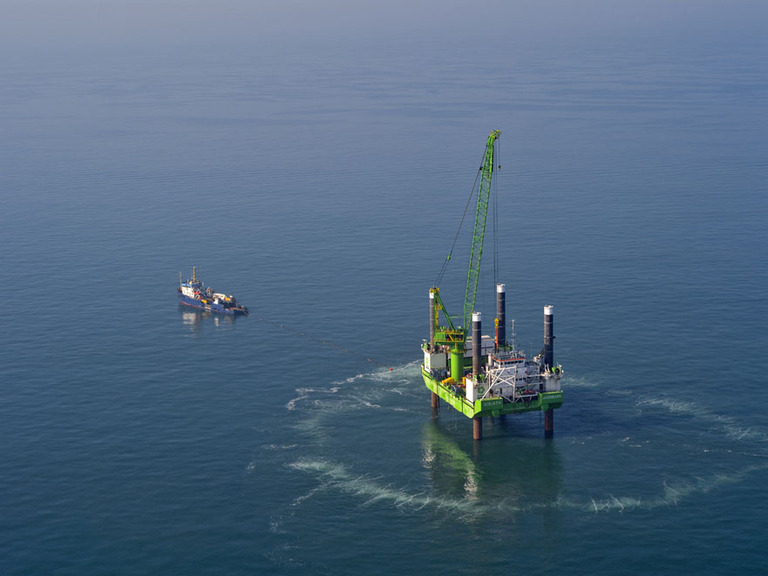
How the large bubble curtain works
A vessel lays a perforated hose on the seabed in a wide circle around the foundation. Compressed air is pumped through the hose; the rising bubbles form a ring that completely encloses the pile-driving site and dampens the spread of sound. How well this works depends on factors such as the air volume and the size and spacing of the holes: during the construction of our wind farm, smaller, more closely spaced holes achieved around 3 dB of additional reduction.